


Cardboard Culture
Exhibition design
The exhibition design is an exciting task in constant evolution that responds to a particular cultural, social, and commercial environment. The latest technological advances allow us to incorporate infinite resources and possibilities never before imagined. This is the case of the use of cardboard, a material that ,for its combination of lightness, strength and easy handling, is ideal for the design of exhibitions, temporary events. It is also a sustainable material, 100% recyclable and reusable. Most cardboard designs for the exhibition we do in Cartonlab are modular systems, whose installation does not require specialized trades, which facilitates assembly and saves money.
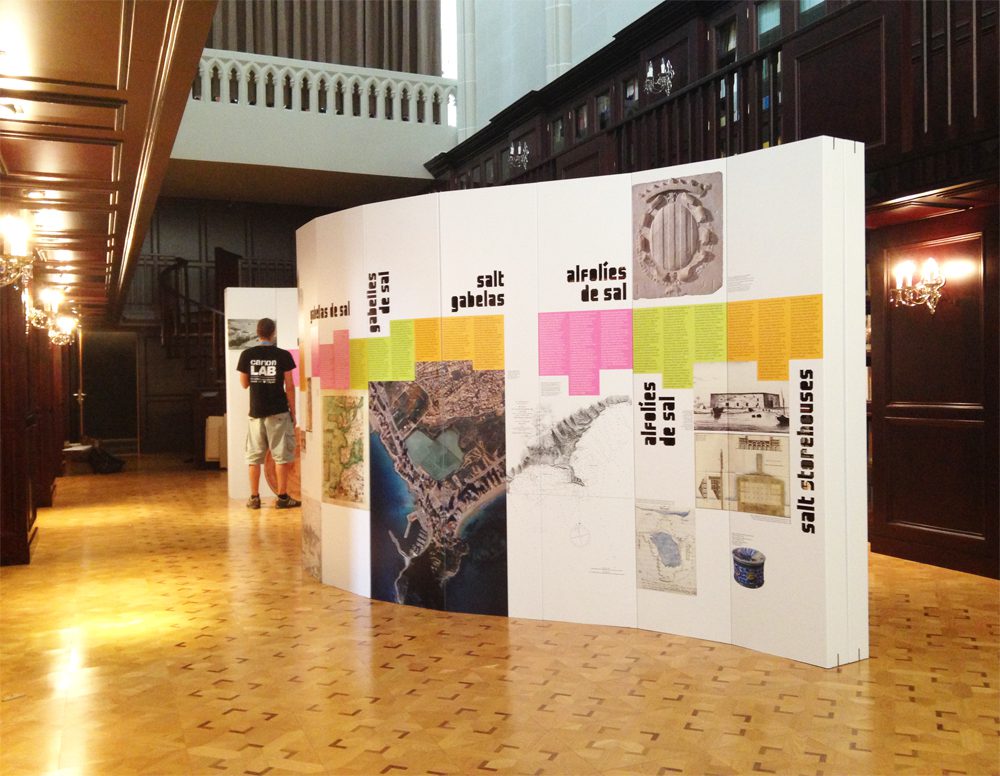
Exhibition of Reino de La Sal. Marq Alicante.
On the other hand, modern manufacturing and digital printing technologies enable the customization of the designs with different systems: punching logos, patterns or letters, direct digital printing on cardboard, or even try with different finishes and textures in the material: varnished, laminated… Below we highlight several examples of exhibition projects we have done in Cartonlab which can serve as an example of the infinite design possibilities offered by cardboard.
EXHIBITION PANEL SYSTEMS (WALLS)
Cardboard structures and cladding panels simultaneously serve as expository structure and as support.

Exhibition 100 years Minateda Site. Hellin Museum. Project coordinated by Vertice Cultural.
The installation of the exhibition for Rock Art Minateda Site for the Museum of Hellin is to date the largest exhibition assembled by CartonLab, with over 70 meters of exhibition, divided into 30 curved units. About this project also stands out the incorporation of LED lighting to highlight the different content areas.
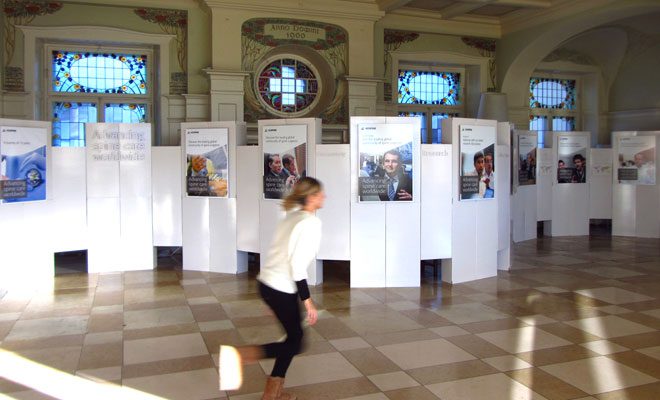
Expository assembly for AOSpine in Davos (Switzerland)
We also participated in the creation of a modular exhibition design for a medical conference in Switzerland. The materials were manufactured in Spain and the assembly was performed in a hotel situated in the Alps, so the lightness and portability of the entire production was the key to facilitate logistics and allow quick assembly.
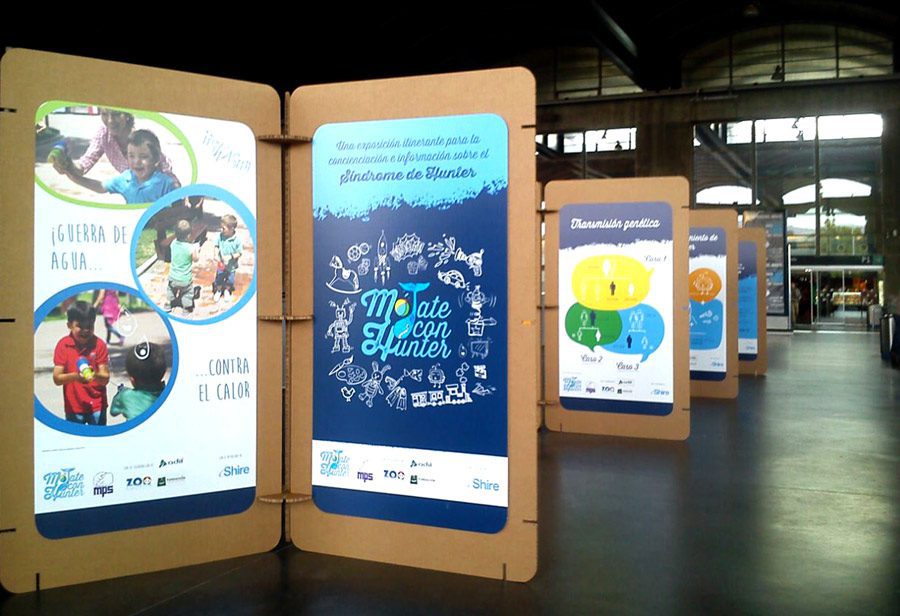
Exhibition “Mójate con Hunter” modular cardboard panel system bee nest printed.
A final example of this category is the solidary campaign Mójate con Hunter, a photographic exhibition with more than 30 images that traveled through the main cities of Spain. This exhibition system stands out for its simplicity and versatility. It allows almost infinite configurations depending on the exhibition spaces available: linear, cross-shaped, zigzag, etc. Also mounting and dismounting are extremely simple.
EXHIBITION TOTEMS
The totems serve as support for the graphic material and they allow a free and flexible arrangement for any exposure. You can print directly the exhibition content or instead the totems can be used as support for multiple exposures panels.
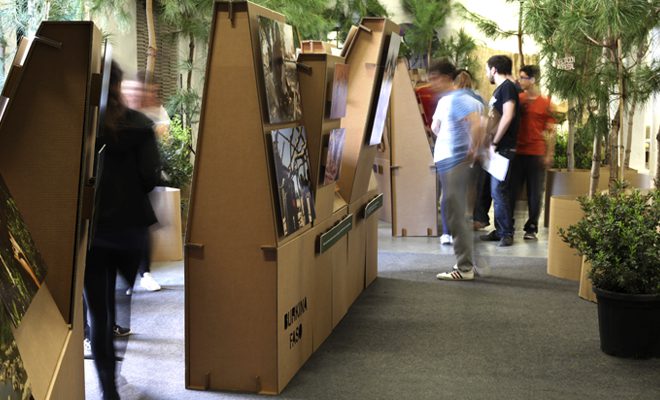
Exhibition “Forest In the World” Cuartel de Artillería de Murcia.
The exhibition Forest in the World sought to create awareness in favor of a comprehensive and sustainable management of forests. Therefore they decided to have exhibitors made of cardboard as a sustainable material that is perfectly integrated with the values of the assembly. For this event, we designed a modular cardboard base, on that base the exhibition material (photographs, panels, etc.) was set independently.

Totems exhibitors. ASA. Sustainability and architecture. WSB Barcelona 2014.
The Asociación Sostenibilidad y Arquitectura (ASA) promoted an exhibition of student work composed of 15 exhibition stands type “Prism” in cardboard and triangular shape. The top of each support was customized with a direct stamp on the cardboard and during the assembly process, the pictures were placed and were printed in the panels’ shape.
SPECIAL PROJECTS
They are particular and special designs according to the needs of each client.
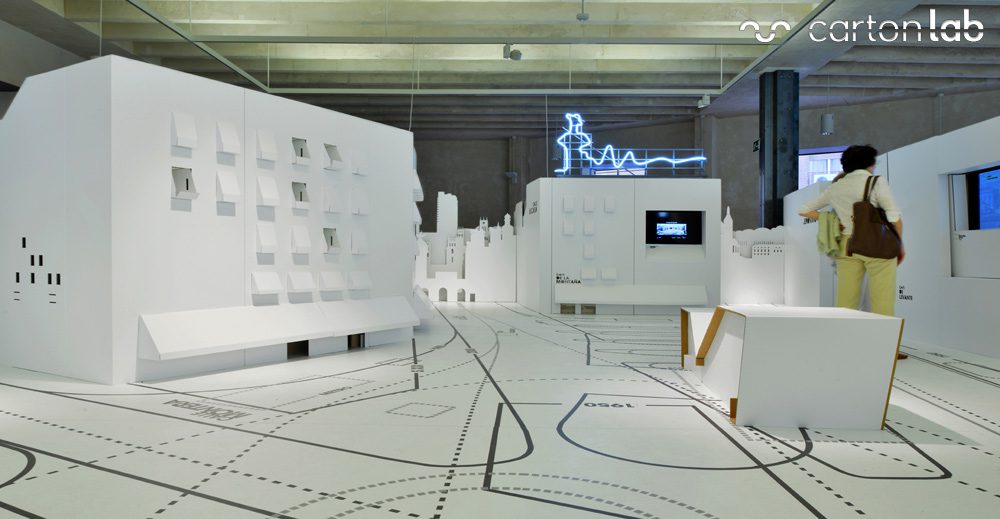
PIENSA SOL exhibition. COAM Madrid 2013.
The Piensa Sol project was one of those particular jobs that consisted of a scale recreation of Puerta del Sol in Madrid. It was a 300m2 exhibition design representing a cardboard mini-city. To it, we incorporated some multimedia devices such as flat screens, ipads, lighting… so that visitors can interact with the exhibition.
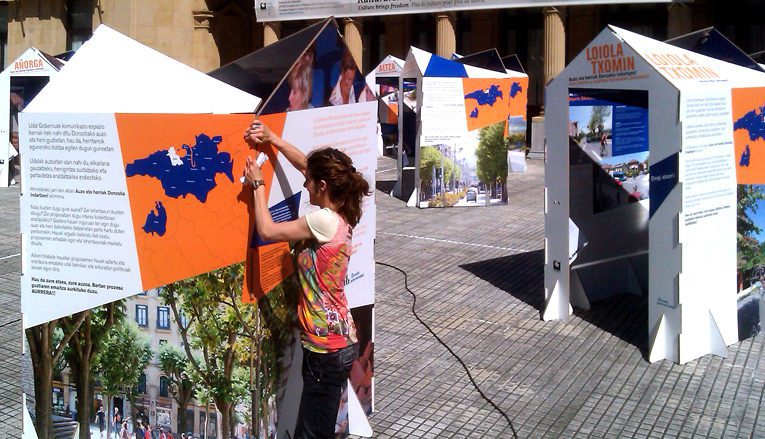
Habited Neighborhoods Project. with VITO21 agency. San Sebastian.
Finally, for an exhibition about citizen participation, we conducted cardboard structures with house shape, forming a little city. In this one, the highlight was the use of cardboard in an exhibition designed for outdoor installation at various locations in the Basque Country.
Article by: Andrea Werner Ros.